Your members decide to leave weeks before they cancel.

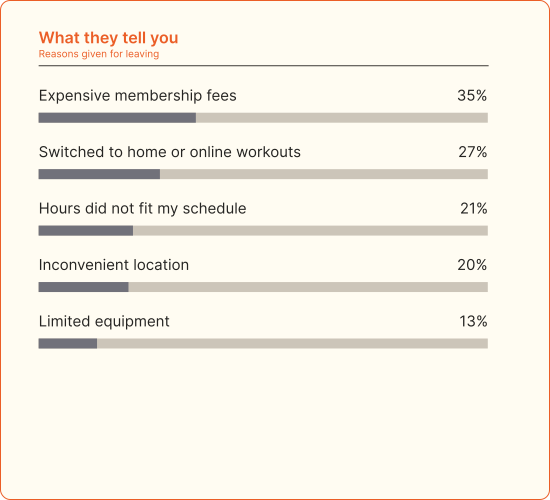
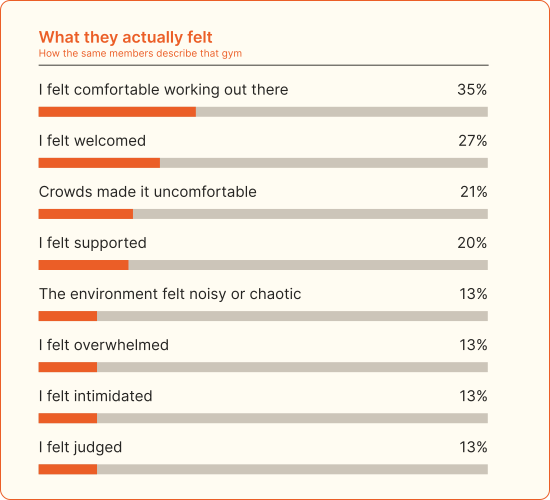
Ask a gym why members quit and you get one answer: price. Ask 1,069 gym-goers and a different picture appears. People join for cost and location. They leave when the place stops feeling comfortable. Sogolytics catches that shift in week three, not on the exit form.
Findings from The Emotional Triggers of Gym Retention, Sogolytics, February 2026. US national sample. UK study now in field.
Custom Button Book a 20-minute demo Arrow Icon
Custom Button Or get the research report Arrow Icon
See what your exit forms are missing

20 minutes. No commitment. UK team, UK contact.

THE GAP THE PROBLEM

The reason on the cancellation form is almost never the real reason.

A member joins in January. Four visits the first week. Two the second. Then nothing. The membership is still active and still paid, so nothing in your system flags it. When they finally cancel, they tick “too expensive.” Not because it was, but because that is easier to say than “I never felt like I belonged there.” You log it as a pricing problem. You discount. The churn continues.
Stated vs Felt Reasons for Member Churn
The Emotional Triggers of Gym Retention, Sogolytics, February 2026. 1,069 US adults. Multiple responses permitted.


31% of current members say they are likely to leave within six months.

That is not a prediction or a model. It is what members say when someone asks them. Most gyms never do.
~2x
Members who feel intimidated are roughly twice as likely to plan an exit
~50%
Among members who say crowds affect their consistency, nearly half report likely exit within six months
57%

of new Gymgoers would leave if their preferred trainer left against 22% of regular Gymgoers

The Emotional Triggers of Gym Retention, Sogolytics, February 2026.
Every one of those signals is measurable today. None of them appear in a cancellation report.

THE WINDOW

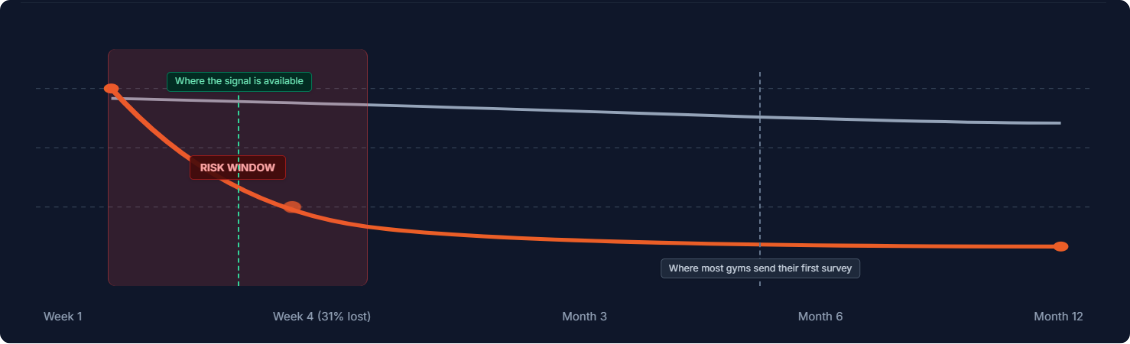
The risk window closes before most gyms send their first survey.

31% of people new to exercise lose motivation within the first few weeks. Another 10% within the first month. Meanwhile 43% of regular Gymgoers say their motivation holds steady, and among advanced Gymgoers 46% say they rarely lose it at all.

Your most vulnerable members are your newest ones. They are also the ones you onboard with a welcome email and a wristband.
VISUAL 2: MOTIVATION DECAY TIMELINE
Motivation Decay Timeline

A NOTE ON TIMING

Only 19% of people set fitness goals in January.

43% set them at random points across the year. Others are triggered by a health scare or an upcoming event. If your onboarding programme runs as a January sprint, it is missing four fifths of the people who walk through your door motivated.
Retention programmes need to run continuously, because intake does.

FREE RESEARCH

The Emotional Triggers of Gym Retention

28 pages on motivation decline, emotional friction, early churn signals, and the three-pillar retention model. Based on 1,069 responses.
US national sample, February 2026. UK study currently in field.

A NOTE ON TIMING

Catch the signal while you can still act on it.

Cloud & Commerce works with UK gym operators to put Sogolytics in place-a listening system timed to the member journey, not an annual satisfaction survey.
Platform partner: Sogolytics
1. Journey-timed listening
Onboarding asks about comfort and confidence. Mid-tenure asks about facilities and value. Each question fires at the stage where the member actually has something to tell you.
2. Real-time alerts
A low comfort score in week two triggers a task, not a quarterly report. Your team gets a name and a reason while the member is still walking through the door.
3. Open-text analysis
AI reads free-text answers at scale and surfaces the pattern. “The locker room” mentioned forty times is a maintenance job, not a mystery.
4. Multi-site benchmarking
Compare comfort scores and NPS across locations. See which site has a crowding problem before it reaches the churn report.

Member Journey Flow

EARLY INTERVENTION BRANCH

Low score → Alert to staff → Intervention → Retained

Automated Closed-Loop Retention Workflow

Sign-up
Baseline expectations
Week 1 Onboarding
Confidence and orientation
Week 3 Check-in
Comfort score
Month 3 Pulse
Facilities and value
Month 6 NPS
NPS and advocacy

A NOTE ON TIMING

One example: the trainer you are about to lose

57% of new Gymgoers say they would leave if their preferred trainer left. Among regular Gymgoers that figure is 22%. When a trainer hands in notice, you are not losing one relationship. You are losing a specific set of beginners who were relying on that person to feel comfortable.

Sogolytics tells you which members those are, before the resignation letter.

IN PRACTICE

Used by multi-site health club operators

Retention Calculator

Calculate your estimated annual churn loss.

500 3,500 Members 25,000
£15 £45 / mo £150
10% 32% Annual Churn 60%
Estimated Annual Churn Revenue Lost
£604,800
Estimated Revenue Retained with Early Signals
(~15% Recovery)
£90,720

RETENTION CALCULATOR

Find out what your exit forms aren't telling you.

Twenty minutes with our team. We will walk through your member journey and show you where the retention signal is going missing.
Book your 20-minute demo

20 minutes. No commitment. UK team, UK contact.

The three things operators ask us first.

That is not a prediction or a model. It is what members say when someone asks them. Most gyms never do.
"We already survey our members."
Most gyms survey after the member has already disengaged. The difference here is timing and trigger, not volume. You will likely send fewer surveys, not more.
"We don't have anyone to run this."
Templates come pre-built for fitness. Alerts route to whoever is on shift. If you would rather hand the whole thing over, Sogolytics runs managed research as a service.
"Our members won't fill in surveys."
Short, mobile-first questions at moments members actually care about. One comfort question in week two outperforms a twenty-question annual review, and it arrives while you can still act on the answer.

FREE RESEARCH

The Emotional Triggers of Gym Retention

28 pages on motivation decline, emotional friction, early churn signals, and the three-pillar retention model. Based on 1,069 responses.
US national sample, February 2026. UK study currently in field.