

Enablement Drives Execution. That’s What Unlocks Partner Growth.
14 April 2026


Redmond Orme
Fractional Global Partner Director | Scaling B2B SaaS & eCommerce | Channel Strategy & GTM Specialist | Consultant @ Cloud and Commerce
Share with your community!
Part 1 - Enablement Drives Execution. That’s What Unlocks Partner Growth.
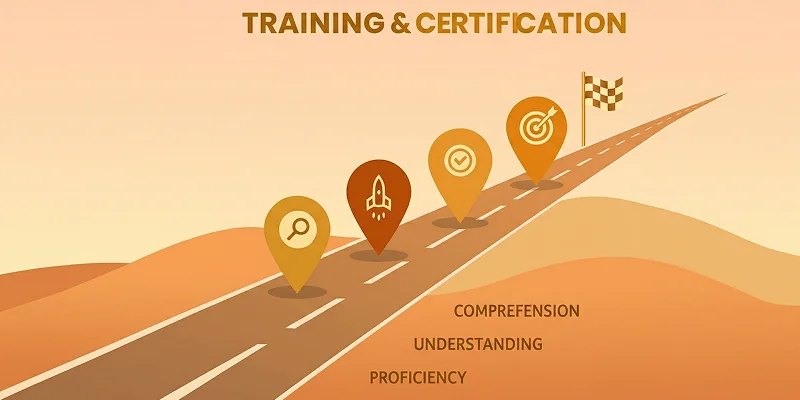

1. Training & Certification
It has to be lean, practical, and tied to outcomes.
Partners won’t show up if the time cost outweighs the sales benefit. Overengineered certifications don’t build trust; they create drop-off. Design training that makes partners feel confident walking into a room, not just ticking a box
2. Demand Generation & Co-Marketing
Ditch the white-labelled content libraries gathering dust.
Give partners visibility into real campaigns, messaging, and strategic events. For key partners and those capable of scale, shift toward concierge-style GTM support as soon as possible. That’s when flywheels start to spin.
OpenView Partners highlights that ecosystem-led companies outperform peers in CAC (Customer Acquisition Cost is a key measure often assessed vs. “direct sales”) efficiency and capital leverage. This is so important, as investors are now actively looking for signs of mature partner GTM models in later funding rounds and capital markets when pricing a business for IPO.
We’ll be investigating how channels and alliances drive valuation multiples in a future installment of this series.

3. Automation & Self-Service Infrastructure
Senior leadership teams want their businesses to scale via channels and alliances. It’s one of the best growth levers to pull – but only when it’s done right. This is where automation helps.
Vendors often over-engineer self-service, expecting partners to pick up too much of the slack. PRM<->CRM sync, real-time updates, intuitive and lightweight flows are what actually make systems work. Automation should reduce friction — not offload the vendor’s responsibility.
IDC reports that vendors with fully integrated partner operations see a 30% increase in partner-led deal velocity — because the experience is seamless and repeatable.
4. Sales Execution Support
Co-sell activity is one of the most important parts of ecosystem maturity. A pure re-sell play might be your end goal, but it’s highly likely you’ll come through here with most partners first.
It’s where two (or more) organizations align, collaborate, and learn from each other in-market. Don’t force a one-size-fits-all playbook. Ask what your partners need to win then build around that. When you keep the customer at the centre, you create frictionless experiences for partners and seamless ones for customers.
Today’s solutions are often complex and require key integrations, budgets are constrained, expectations on the RoI timeline are compressed. Nobody can afford to make mistakes. Doing all this gives customers the confidence to move forward with you and your partner.
5. Lifecycle Engagement Strategy
Most vendors see 20% of partners generating 80% of channel revenues (the 80/20 model). That usually means you’re managing 5× more partners than you need and burning out your channel managers.
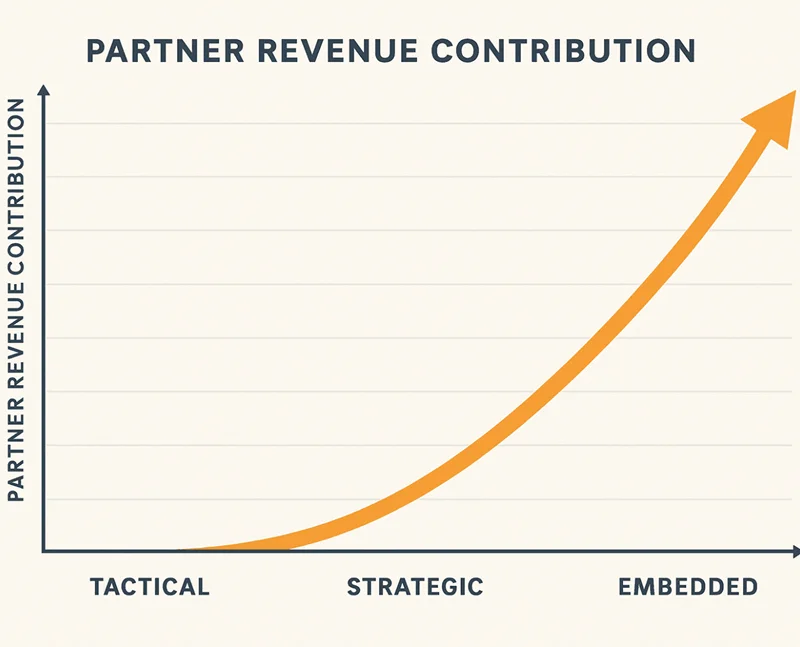
Focus on those partners who are aligned and progressing along the arc of autonomy, the path from influence to co-sell to scalable contribution. Everyone else? Shift to referral or affiliate tiers and keep it lean.
Bain & Company found that programs that actively focus enablement around their top-performing 40% of partners account for up to 80% of total indirect revenue growth, not by scaling headcount, but by doubling down on execution.
Some further observations – let’s be clear: getting partners up the arc of autonomy isn’t obvious or easy.
Partners no longer fit into neat, static boxes. One day they’re influencing. The next, they’re co-selling. In some regions, they’re leading delivery; in others, they’re handing you a qualified opportunity. Rigid enablement fails because it assumes fixed roles, but partner reality is fluid.
Your program has to support the execution mode, not just the partner type. Meet them where they are and give them the tools, messaging, and support to move forward.
Because at the end of the day, we’re trying to build referencability, drive customer satisfaction, grow our brands, and beat the competition.
Next in the series: Why GTM alignment matters more than most partner programs realise.
Looking to enter or growing in new markets?
