

What Comes Next
05 June 2026


Redmond Orme
Fractional Global Partner Director | Scaling B2B SaaS & eCommerce | Channel Strategy & GTM Specialist | Consultant @ Cloud and Commerce
Share with your community!
Part 3 - What Comes Next
Every industry eventually reaches the point where more of the same stops working.
For SaaS, that point is now. Not because the software got worse, or because buyers stopped having problems worth solving but because the model that served the industry so well for so long has started to work against the outcomes it was supposed to deliver.
The response to that, for a lot of vendors, has been to double down. More features. Better integrations. Improved onboarding. Lower friction at the point of sale. These are reasonable responses to the symptoms. They’re less useful as responses to the underlying condition.
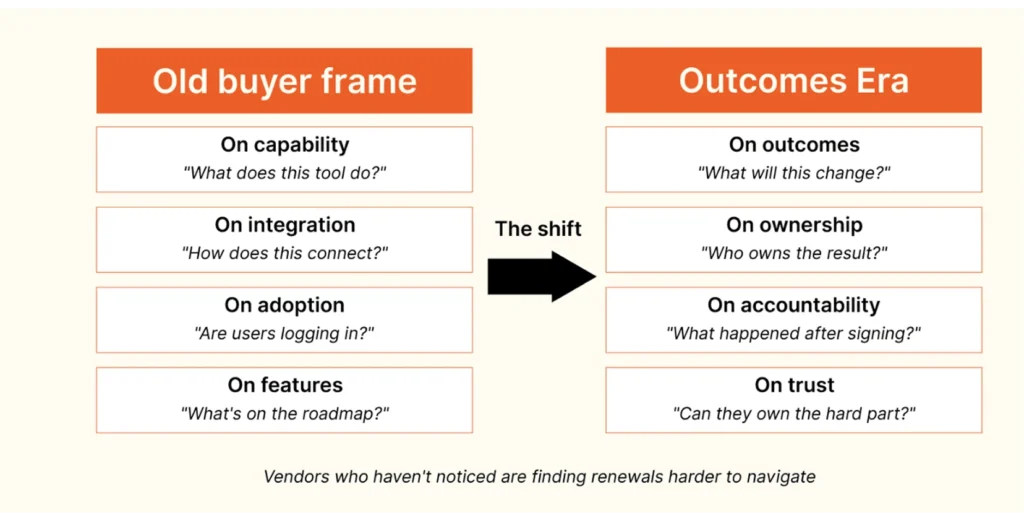
What’s actually changing — quietly, unevenly, but with increasing momentum — is the question buyers are starting with. Not “what does this tool do?” but “what will this actually change?” Not “how does this integrate with what we have?” but “who is going to own the outcome here?” The frame has shifted from capability to accountability, and vendors who haven’t noticed yet are finding renewal conversations increasingly difficult to navigate.
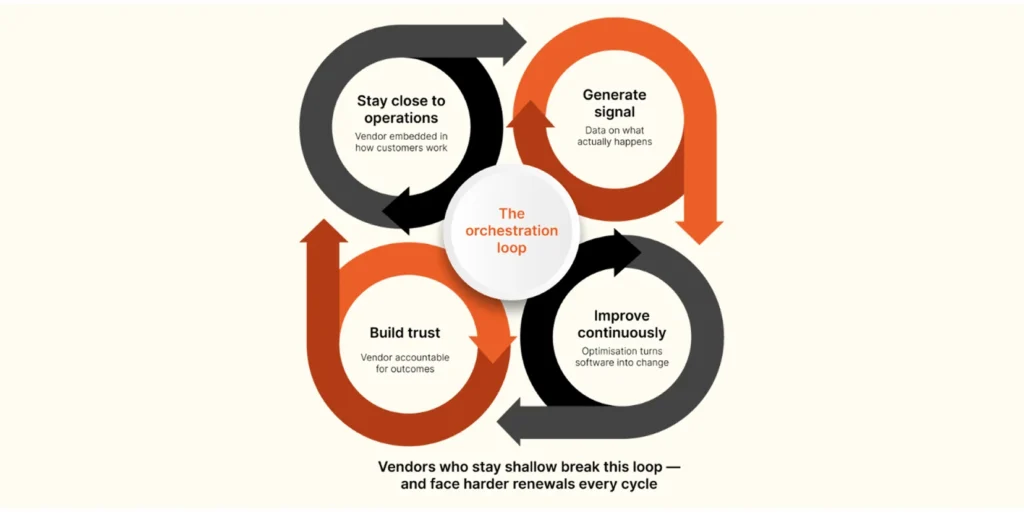
The organisations that are responding well to this aren’t necessarily the ones with the most sophisticated products. They’re the ones who’ve made a different kind of commitment — to owning more of the environment, to staying closer to the data, to being accountable for what actually happens after the contract is signed.
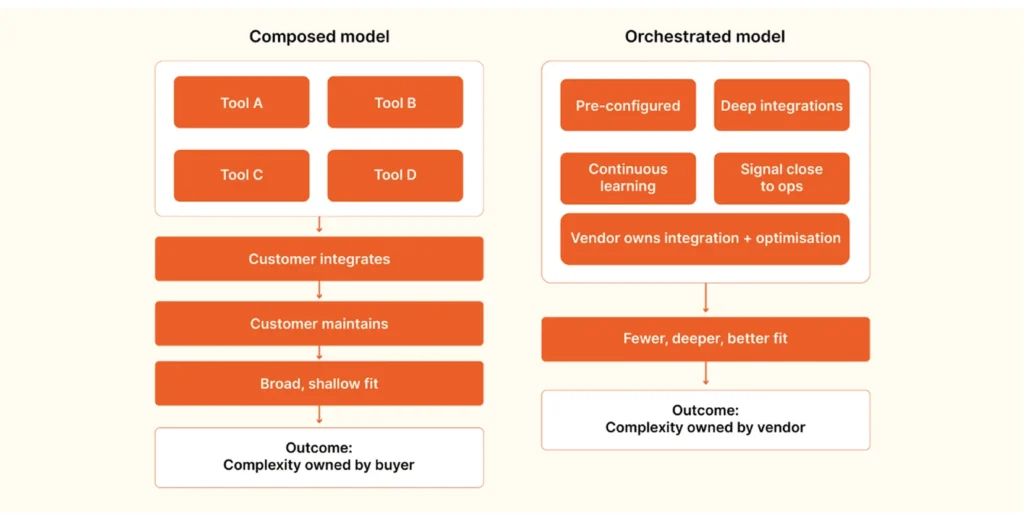
In practical terms, that looks like fewer, deeper integrations rather than broad but shallow connectivity. It looks like pre-configured solution environments rather than components that require assembly. It looks like platforms that learn and improve continuously, because they’re close enough to how customers actually operate to generate the signal that makes improvement possible.
None of this is straightforward to build. It requires a different commercial model, a different relationship with the customer, and a willingness to be measured against outcomes rather than adoption metrics. That’s a harder thing to sell in a quarterly earnings call. It’s also, increasingly, the only thing that sophisticated buyers want to hear.
There’s something genuinely exciting about where this leads. The SaaS model, at its best, was always about making capability more accessible — taking something that used to require enormous resources and making it available to organisations that couldn’t previously afford it. The next phase extends that logic. Not just accessible capability, but accessible outcomes. Not just tools that could solve a problem, but environments that reliably do.
The vendors who get there first won’t win by having better features. They’ll win by being the ones their customers trust to own the hard part — the integration, the optimisation, the continuous improvement that turns software into something that actually changes how a business operates.
That’s a different kind of company to build. But the market is starting to ask for it clearly enough that the direction of travel feels increasingly obvious.
The next generation of SaaS won’t be composed. It will be orchestrated.