

Data That Drives Action
24 April 2026


Redmond Orme
Fractional Global Partner Director | Scaling B2B SaaS & eCommerce | Channel Strategy & GTM Specialist | Consultant @ Cloud and Commerce
Share with your community!
Part 3 - Data That Drives Action
The 3 Metrics That Actually Move a Partner Program
Most partner teams aren’t short on data. If anything, they’re drowning in it.
Dashboards, scorecards, quarterly reviews and executive reports all filled with charts tracking dozens of indicators. It’s not unusual to see twenty or more KPIs being monitored at any given time and yet the outcomes often look the same.
Revenue doesn’t accelerate. Partner engagement plateaus. Enablement investments struggle to translate into consistent execution. The problem isn’t a lack of measurement. It’s a lack of focus.
After working across a number of B2B SaaS partner ecosystems, I’ve found that a small number of metrics tend to drive meaningful behaviour change. Many others are interesting, but only a few consistently reveal whether a partner program is truly working.
Three signals, in particular, tend to tell the clearest story.

The first is time-to-first-revenue.
Among all the metrics available to partnership leaders, this is one of the most underrated. It asks a simple question: how long does it take for a newly onboarded partner to close their first deal?
- Not to complete certification.
- Not to attend onboarding sessions.
- But to generate real revenue.
That timeline reveals a surprising amount. It exposes whether onboarding is commercially aligned, whether enablement is practical rather than theoretical, and whether internal sales teams are genuinely collaborating with partners. When time-to-first-revenue stretches too far, momentum fades quickly. Partners shift their attention to vendors who provide faster traction.
Shortening this cycle is often one of the most effective ways to strengthen partner commitment.
The second signal is pipeline health.
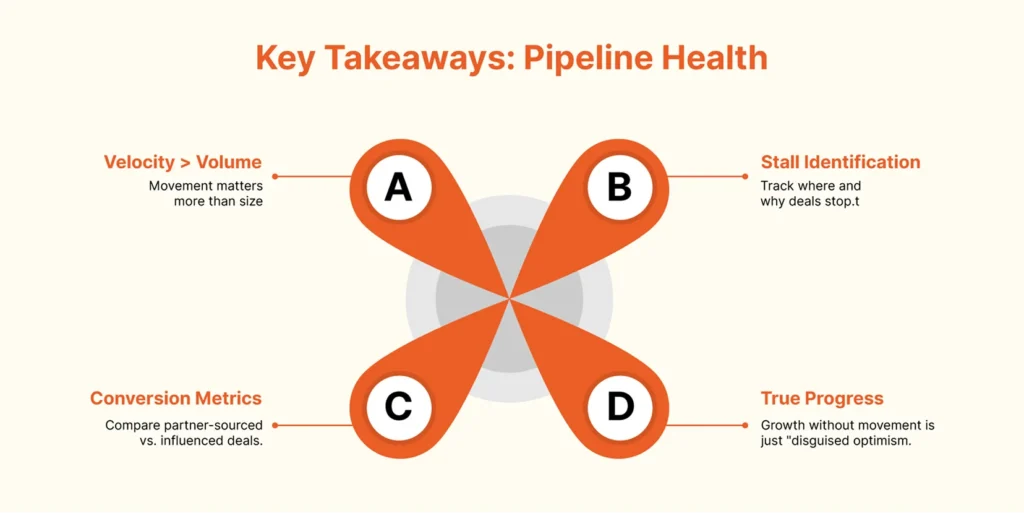
Pipeline size often looks impressive in board presentations, but volume alone rarely tells the full story about the health of a partner motion. What matters far more is how the pipeline behaves how quickly opportunities move through stages, where deals tend to stall, and how partner-sourced opportunities convert compared to influenced ones.
A pipeline that grows but rarely progresses isn’t strength. It’s optimism disguised as progress.
Healthy pipelines move. They convert. They reveal patterns about which partners and motions actually drive revenue.
The third metric is enablement engagement.
Vendors invest heavily in partner portals, training academies, and content libraries designed to support their ecosystems. But the sophistication of those resources matters far less than whether partners actually use them.
Engagement levels provide an early signal of relevance. Are partners logging in, attending sessions, and using the materials available to them?
When engagement drops, the issue is rarely partner motivation. More often the content is too generic, lacks clear commercial relevance, or simply isn’t easy to access within the day-to-day rhythm of partner sales teams.
Enablement should reduce friction. When it increases it, partners quietly disengage.

What does this all mean?
Seen together, these three signals reveal something many dashboards obscure: the purpose of measurement is not simply to observe activity, but to trigger action.
When time-to-first-revenue stretches, onboarding and partner selection need attention. When pipeline velocity slows, the co-sell motion often needs adjustment. When enablement engagement drops, it’s usually a signal that relevance has drifted.
Data should create clarity. Clarity should drive decisions and those decisions should change behaviour.
If your dashboards aren’t influencing how people act, they’re not driving growth, they’re just decoration.
A useful exercise for any partner leader is a simple one: imagine removing eighty percent of the metrics currently tracked in your program.

Which ones would remain?
Strong ecosystems aren’t built on the volume of activity they produce. They’re built on clarity of focus and clarity starts with what you choose to measure.
Next in the series: Why ecosystem strategy is shifting from GTM to GTWe.
- Part 1 - Enablement Drives Execution. That’s What Unlocks Partner Growth.
- Part 2 - GTM Alignment Without Burning Out Partner Teams
- Part 4 - The Real Shift: From GTM to GTWe
- Part 5 - The Hardest Lesson in Building Partnerships
- Part 6 - The Rise of the hybrid partner
- Part 7 - Why the Next Decade Belongs to the Partner Ecosystem
Looking to enter or growing in new markets?
